If you’re an employer considering taking on an apprentice in 2026, the financial support available has never been stronger. The government has announced a package of incentives designed to make hiring young apprentices significantly more attractive, particularly for small and medium-sized businesses.
he government is offering up to £5,000 in stacked incentives for employers who hire young apprentices in 2026. Four separate payments are available depending on your size, the apprentice’s age, and their circumstances. Most payments go via the training provider, not directly to you , and the first instalment won’t realistically arrive until 110-130 days after the apprenticeship starts.
The headline figures are real, but the payment timelines aren’t instant. Understanding exactly what you’re entitled to, when the money actually lands, and who it comes through is the difference between a positive experience and a frustrated phone call to your training provider three months in.
This guide breaks down every incentive available, who qualifies, and, critically, what the realistic payment timeline looks like.
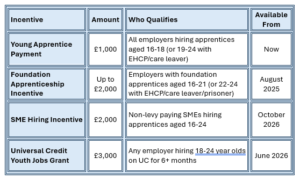
The Four Incentive Payments at a Glance
The £1,000 Young Apprentice Payment
£1,000 Available Now • All Employers
This is the existing incentive that has been running for some time and continues into 2026. If you hire an apprentice aged 16-18, or one aged 19-24 who has an Education, Health and Care Plan (EHCP) or is a care leaver, you receive £1,000.
The payment is made in two equal instalments of £500. It goes from the government to your training provider, who then passes it on to you. It is not deducted from your apprenticeship service account , it’s an additional payment on top of training funding.
The £2,000 Foundation Apprenticeship Incentive
Up to £2,000 From August 2025 • All Employers
Foundation apprenticeships are shorter programmes designed for younger learners, typically lasting at least eight months. If your apprentice is on an eligible foundation apprenticeship, you can receive up to £2,000.
Eligibility is for apprentices aged 16-21, extended to 22-24 for those with an EHCP, care leavers, or those who are or were in custody. The payment is made in three instalments and, like the £1,000 payment, goes via the training provider.
Foundation apprenticeships launched in engineering, manufacturing, and digital sectors, with catering, hospitality, and retail expanding from April 2026.
The £2,000 SME Hiring Incentive
£2,000 From October 2026 • Non-Levy / SMEs Only
This is a brand-new incentive announced as part of the government’s plan to create 50,000 more apprenticeships for young people. From 1 October 2026, non-levy paying small and medium-sized employers will receive £2,000 for every apprentice they hire aged 16-24.
There’s an important timing condition: the apprentice must have joined the employer within the previous three months. So if the apprenticeship starts on 1 October 2026, the apprentice needs to have been employed no earlier than 1 July 2026.
This is on top of the fact that SMEs already pay no training costs for eligible under-25 apprentices (the government covers 100% of training and assessment up to the funding band maximum), and there are no employer National Insurance contributions for apprentices under 25 earning below £50,270.
The £3,000 Universal Credit Youth Jobs Grant
£3,000 From June 2026 • All Employers
This is the largest single incentive and it’s available to all employers, not just SMEs. If you hire an 18-24 year old who has been claiming Universal Credit for six months or more, you receive £3,000.
This incentive is expected to support 60,000 young people over three years. Critically, this is the one payment that goes directly to the employer, not via the training provider.
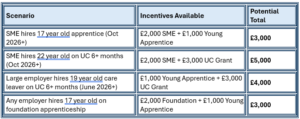
The Youth Jobs Grant can be combined with other apprenticeship incentives. That means if you’re an SME hiring a 20 year old who’s been on UC for six months as an apprentice from October 2026, you could potentially receive the £3,000 UC grant plus the £2,000 SME hiring incentive , £5,000 in total.
How the Payments Stack
Here’s where it gets interesting. Depending on the apprentice’s age, your business size, and their circumstances, multiple incentives can apply to the same hire.
When the Money Actually Arrives
This is the section that matters most for employers.
The headline says a payment of £2,000 or £3,000. What it doesn’t say is that most of these payments are made in at least two instalments, with the first payment triggered at around day 90 of the apprenticeship.
But that’s day 90 for the department to process the payment. The money then goes to the training provider, who passes it on to the employer. By the time that chain completes, you’re looking at a realistic timeline of 110-130 days from the apprenticeship start date before you see your first instalment.
Here’s what that looks like in practice:
Day 1 : Apprenticeship starts. Clock begins.
Day 90 : First instalment triggered by the Department for Work and Pensions.
Day 90-110 : Payment processed and sent to training provider.
Day 110-130 : Provider passes payment on to employer.
Later: Second (and potentially third) instalments follow the same pattern at later milestones.
Why this matters for your business planning: If you’re factoring incentive payments into your hiring budget, don’t expect to see any money for at least 4 months. The payment is real, and it will come, but treating it as immediate income is a recipe for frustration. Plan your cash flow on the basis that incentive payments are a bonus that arrives later, not a subsidy you can spend on day one.
The exception is the £3,000 Universal Credit Youth Jobs Grant, which goes directly to the employer. This may have a slightly faster timeline since it skips the provider step, but the Department’s processing time still applies.
What About Training Costs?
The incentive payments above are separate from training funding. Here’s what you actually pay for the apprenticeship itself:
- SMEs (non-levy) with apprentices under 22: The government covers 100% of training costs up to the funding band maximum. You pay nothing.
- SMEs (non-levy) with apprentices aged 22-24: The government covers 100% if they have an EHCP or are a care leaver. Otherwise, you pay 5% co-investment.
- Levy-paying employers: Training costs come from your levy pot. When the levy is exhausted, co-investment of 25% applies (up from 5% under the new Growth and Skills Levy rules from April 2026).
Frequently Asked Questions
Can I claim more than one incentive for the same apprentice?
Yes. The incentives can stack depending on the apprentice’s age, your business size, and their personal circumstances. An SME hiring a 20 year old who has been on Universal Credit for six months could receive the £2,000 SME incentive and the £3,000 UC Youth Jobs Grant, £5,000 in total.
What if my apprentice turns 25 during their programme?
Eligibility for incentive payments is typically assessed at the start of the apprenticeship, not during. If they were eligible when they started, the payment schedule continues as normal.
Do I need to apply separately for each incentive?
For most incentives, your training provider handles the claim on your behalf. The exception is the Universal Credit Youth Jobs Grant, where the process may differ since it goes directly to the employer. Speak with your provider and your local Jobcentre Plus to ensure everything is in place.
How does this affect my Growth and Skills Levy pot?
These incentive payments are entirely separate from your levy. They don’t come out of your Digital Apprenticeship Service account and don’t reduce your available levy funding. They’re additional money from the Department for Work and Pensions.
What if the apprentice leaves before the payment milestones?
If the apprentice leaves before a payment milestone is reached, you won’t receive that instalment. Payments are tied to the apprentice remaining on programme. This is another reason to invest in a quality onboarding experience and strong early support; retention matters financially as well as developmentally.